Every
year, on the full moon day (Purnima) of the vedic month of Ashadha, India
celebrates one of its most sacred spiritual
festivals—Guru Purnima. Unlike festivals that commemorate a particular event or
deity, Guru Purnima is dedicated to honouring the Guru, the one who dispels the
darkness of ignorance and awakens the light of higher knowledge. It is a day of
gratitude, reflection, and remembrance of the timeless vedic tradition that has
preserved the wisdom of the Vedas for thousands of years.
In today's
fast-paced world, where
information is abundant
but inner fulfilment often seems elusive, Guru Purnima serves as a gentle reminder
that true knowledge is not merely accumulated—it is realised. The Vedic
tradition teaches that while books can provide information, it is the guidance
of an enlightened teacher that enables one to experience the deeper truths of
life.
"Knowledge from an enlightened master breaks upon the hard rocks of ignorance"- Maharishi Mahesh Yogi
For
practitioners of Transcendental
Meditation, Guru Purnima is a deeply meaningful occasion to honour the
lineage of enlightened teachers, especially His Divinity Swami Brahmananda Saraswati
(Gurudev) and his disciple, His Holiness Maharishi
Mahesh Yogi, whose dedication
has made this timeless knowledge accessible to people across the world.
The Importance of Guru Purnima
The Importance of Guru Purnima extends far
beyond rituals and ceremonies. It celebrates
the eternal relationship between the Guru and the seeker—a relationship founded on wisdom,
compassion, and the desire to uplift human life.
The Sanskrit
word Guru is traditionally understood
as the one who removes darkness (Gu) and brings the light of knowledge (Ru). In the Vedic
tradition, a Guru is not simply a teacher of philosophy or scriptures but
one who has directly realised higher consciousness and is therefore capable of
guiding others towards the same experience.
This reverence is beautifully expressed
in the ancient verse from Skanda Purana:"Na Guror Adhikam
Tatvam, Na Guror Adhikam Tapah; Na Guror Adhikam
Jnanam, Tasmai Shri Gurave Namah."
"There is no principle greater than the Guru, no austerity greater
than dedication to the
Guru, and no knowledge higher than the Guru, who embodies Total
Knowledge."
Guru Purnima
therefore reminds us that the highest education is not limited to intellectual
learning. It is about expanding awareness, cultivating wisdom, and discovering the deeper purpose
of life through
the guidance of an enlightened teacher.
The Vedic Understanding of Knowledge
India's spiritual heritage has always recognised that education has two dimensions. The Mandukya Upanishad describes
these as Apara Vidya and Para Vidya.
Apara Vidya refers to worldly knowledge—the education, skills, sciences,
and disciplines that help us
earn a livelihood and contribute meaningfully to society. It is essential for
personal and professional growth and forms the foundation of modern life.
Yet the sages
also recognised that material success alone cannot provide lasting fulfilment.
For this reason, they spoke of Para
Vidya, the knowledge of the Self—the transcendental field of pure consciousness that lies beyond thought and underlies every aspect of life.
The role of the Guru is to bridge
these two dimensions. While encouraging excellence in worldly responsibilities, the Guru also guides the seeker
towards inner awakening, enabling life to become both successful and
meaningful. Guru Purnima celebrates this unique contribution of the Guru, who
transforms knowledge into direct experience.
Guru Purnima Celebration in India: Honouring the Vedic Tradition
The Guru Purnima
celebration in India reflects one of the oldest and most cherished traditions of the country.
Across temples, ashrams, meditation centres, educational institutions, and homes, people gather to express gratitude
to their teachers
through prayers, meditation, discourses, and acts of service.
This tradition
is deeply rooted in the Guru-Shishya Parampara, the unbroken lineage through which the wisdom of the
Vedas has been preserved across generations.
Throughout Indian history, seekers
travelled great distances in search of enlightened
masters who could guide them beyond intellectual understanding towards direct experience.
The lives of
Nachiketa, who received the highest wisdom from Yama in the Katha Upanishad, Adi Shankaracharya, who
revitalised Vedic knowledge across India, and countless saints and sages all reflect
the enduring significance of the Vedic tradition.
Guru Purnima
is therefore much more than a festival. It is a celebration of gratitude for the timeless wisdom that continues to
illuminate human life through enlightened teachers.
Gurudev: The Living
Embodiment of the Vedic Tradition
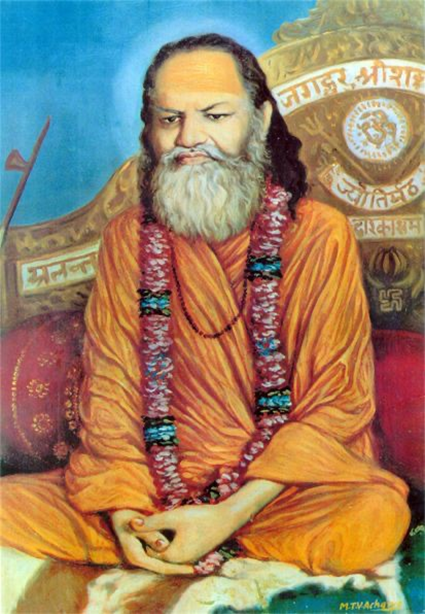
Among
the great spiritual luminaries of modern India, His Divinity Swami
Brahmananda Saraswati, affectionately known as Gurudev, stands as one of the finest examples
of the Vedic tradition.
Born near
Ayodhya as Raja Ram, he displayed a profound spiritual inclination from an
early age. Driven by an intense longing for Truth, he left home in search of an
enlightened master and devoted years to meditation, study, and spiritual
discipline under the guidance
of his Guru. His quest
was not for scholarship alone,
but for direct realisation of the knowledge
described in the Vedas.
In time, he became the Shankaracharya of Jyotirmath, one of the four principal
monastic seats established by Adi Shankaracharya. Through his profound
wisdom, simplicity, and compassion, Gurudev's profound wisdom attracted
scholars, saints, administrators, and national leaders alike. Among those who
sought his guidance was India's first President, Dr Rajendra Prasad, who spent considerable time listening to Gurudev's discourses, reflecting the deep
respect he commanded across the country.
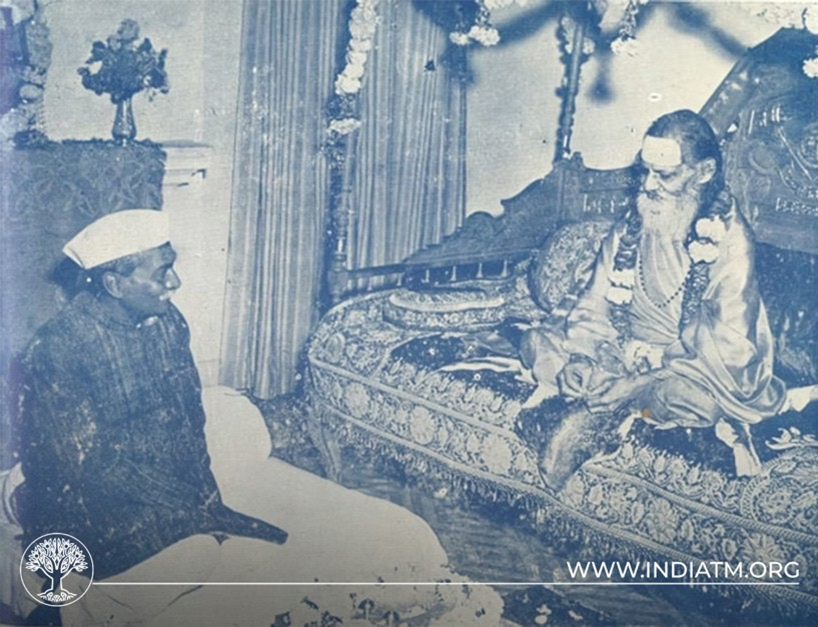
Shankaracharya
Swami Brahmanand Saraswati and President of India Dr Rajendra Prasad, Delhi, 4th December
1952 (Illustration from 'Beacon Light of the Himalayas')
Another Former
President of India,
Dr. S. Radhakrishnan, is said to have referred to him
as the "Vedas Incarnate," reflecting the immense respect he commanded
among scholars and spiritual leaders alike.
Gurudev consistently reminded
people that while every individual strives for comfort, security, and success,
the true purpose of human life extends beyond material fulfilment. Human
birth offers the unique opportunity to unfold the infinite potential of consciousness and attain lasting peace and enlightenment.
Maharishi Mahesh Yogi: Carrying Forward His Guru's Vision
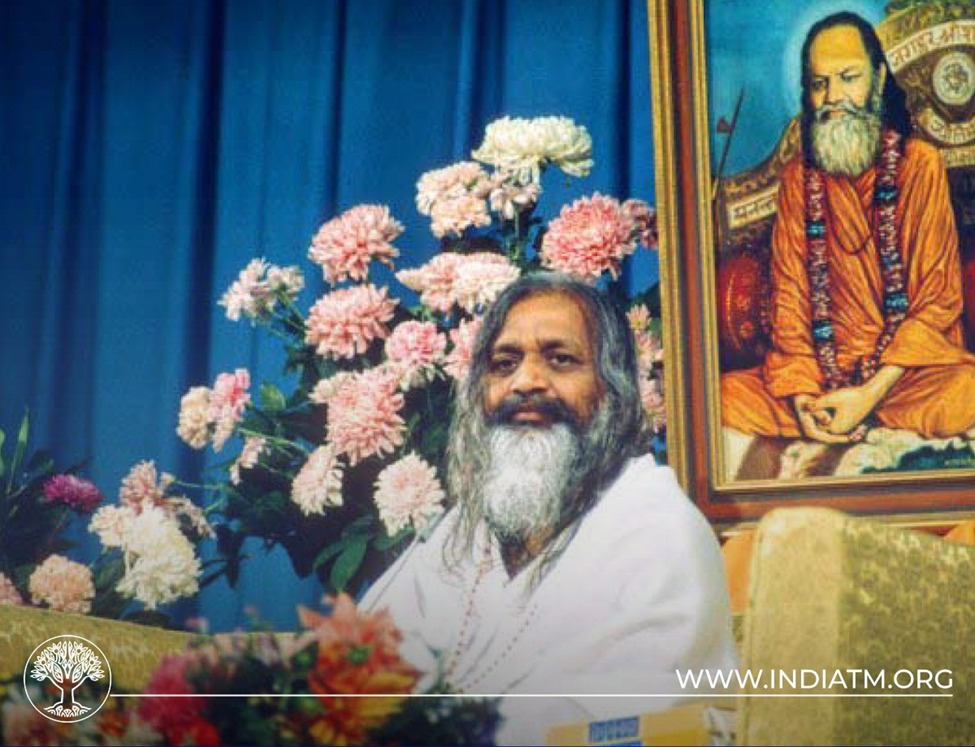
The relationship between Maharishi
Mahesh Yogi and
Gurudev beautifully illustrates how this Vedic tradition has
been preserved.
As a young man, Maharishi came
into the presence of Gurudev and was deeply moved by his wisdom and spiritual stature.
He dedicated himself
wholeheartedly to serving
his Guru, assisting in every aspect of the ashram's activities,
organising programmes, preserving Gurudev's teachings, and serving visitors
with humility and devotion.
Throughout
his life, Maharishi never regarded his achievements as personal
accomplishments. He repeatedly acknowledged that everything he had been able to
accomplish was solely through the blessings of Gurudev. Whenever people praised
the worldwide growth of his work, Maharishi would lovingly offer all credit at the lotus feet of his Master.
This profound
gratitude is beautifully reflected in the expression "Jai Guru Dev," meaning
"Glory to the Guru." For Maharishi, it was not merely a greeting but a constant reminder that the Guru is both
the source and the inspiration behind all genuine knowledge.
His life remains a remarkable example
of how true discipleship is expressed through humility, service, and unwavering
dedication to carrying forward the Guru's vision.
Guru Purnima and Transcendental Meditation
The relationship between Guru Purnima
and Transcendental Meditation is rooted in Maharishi Mahesh Yogi's lifelong
commitment to fulfilling his Guru's wish of making higher knowledge available
to all.
Following the
Mahasamadhi of his Guru, His Divinity
Jagadguru Shankaracharya Swami Brahmanand Saraswati, in 1953, Maharishi Mahesh Yogi spent
approximately two years (1953–1955) in
deep silence and meditation at Gyansu,
Uttarkashi in the Himalayas. During this period of profound
contemplation, he reflected on his Guru's vision and recognised the need to
make the practical experience of higher consciousness accessible to people
leading active modern lives.
Inspired by this vision,
Maharishi began sharing
the knowledge of Transcendental Meditation in 1955, and in 1958 introduced it to the world through
international teaching tours.
Transcendental Meditation is a simple,
natural, and effortless technique that allows the mind to
settle inward beyond the activity of thought and experience the silent field of
pure consciousness. This direct experience of transcendence provides
profound rest to the mind and
body while promoting greater clarity, creativity, happiness, and inner
stability in daily life.
Today,
Transcendental Meditation is practised by people from diverse cultures,
professions, and backgrounds across the world. For meditators, Guru Purnima is
not only an occasion to express gratitude to Maharishi but also to honour the
entire lineage of enlightened teachers
through whom this timeless knowledge
has been preserved
and transmitted.
The Timeless Relevance
of this Vedic Tradition
In an age where knowledge is
instantly available through books, technology, and artificial intelligence, one may wonder whether the role of the Guru is still relevant.
The answer lies in recognising the difference between
information and transformation. Information expands what
we know; wisdom transforms who we are.
A Guru does not simply provide
answers but guides the seeker towards direct experience of higher consciousness. This inner transformation naturally brings greater clarity, compassion, creativity,
resilience, and fulfilment into every aspect of life.
Guru Purnima
reminds us that while the outer world continues to evolve, the human
search for peace, purpose, and happiness remains unchanged. The Vedic tradition
continues to offer practical guidance for meeting this timeless aspiration.
A Legacy That Continues to Illuminate Humanity
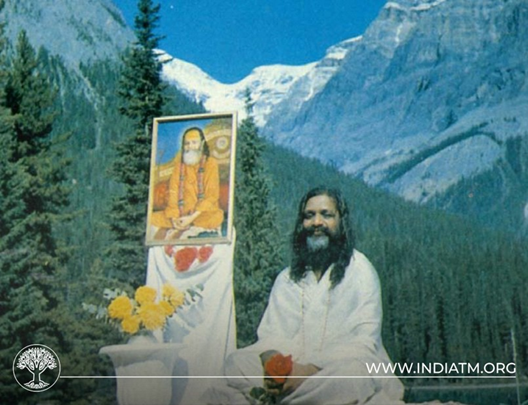
Guru Purnima
is ultimately a celebration of gratitude—the gratitude that arises when knowledge becomes a living reality.
It honours the eternal relationship between the Guru and the disciple, a
relationship built on trust, humility, and the shared journey towards higher consciousness.
The lives of His Divinity Swami Brahmananda Saraswati
and Maharishi Mahesh Yogi
beautifully exemplify this timeless tradition. Gurudev preserved the purity of
Vedic wisdom, while Maharishi fulfilled his Guru's vision by making the
experience of transcendental consciousness available to people throughout the
world through Transcendental Meditation.
As
we celebrate Guru Purnima, we are reminded that the Importance of Guru Purnima lies in expressing gratitude for the
timeless knowledge preserved through this Vedic tradition. The Guru Purnima celebration in India continues to inspire millions
to honour their teachers and
reflect on the higher purpose of life. For practitioners of Transcendental Meditation, this sacred
occasion is a heartfelt tribute to Gurudev and Maharishi Mahesh Yogi, whose
lives demonstrate the enduring power of the Vedic tradition. Their legacy
continues to inspire individuals across generations to discover greater peace,
expanded awareness, and the full potential of human life.